

Home Page » EPR Events » What We Presented at EFEPR 2026: Multiharmonic Analysis and Biomedical EPR
What We Presented at EFEPR 2026: Multiharmonic Analysis and Biomedical EPR
EFEPR 2026 in Brno was an important opportunity for us to discuss how Electron Paramagnetic Resonance is evolving beyond traditional spectroscopy and increasingly becoming a practical tool for biomedical research, advanced signal analysis and emerging medical applications.
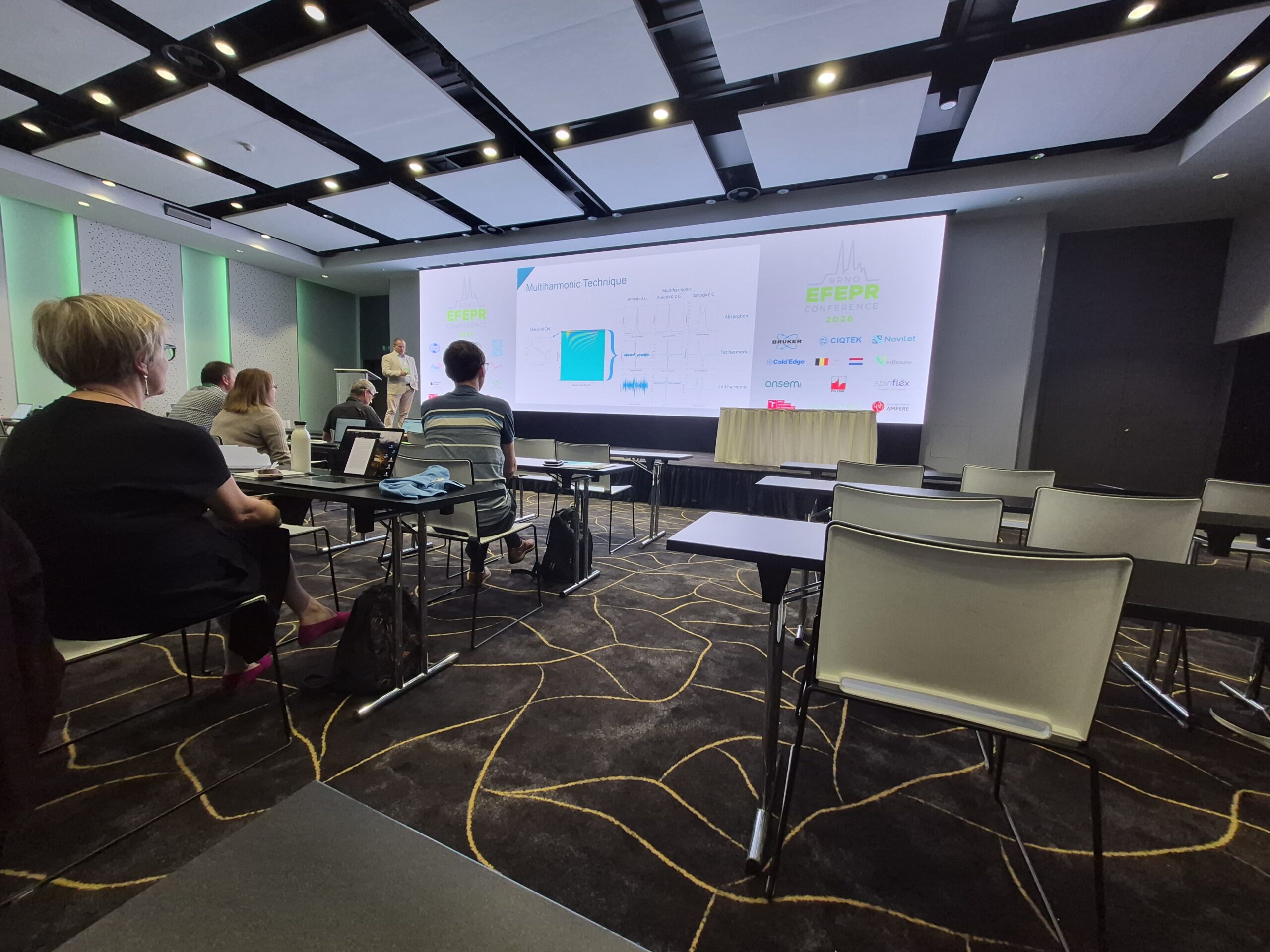
During the conference, Novilet presented several areas of our current work, with particular focus on multiharmonic EPR analysis, advanced signal processing and the growing role of EPR in biomedical applications.
Category
Tags
Table of Contents
Multiharmonic Analysis: Getting More Information from EPR Data
One of the central topics we presented at EFEPR 2026 was multiharmonic analysis.
In conventional EPR measurements, the first harmonic of the modulated signal is typically used for interpretation. Multiharmonic analysis expands this approach by using information contained in multiple harmonics of the EPR signal. The goal is not only to obtain spectra free from modulation effects or to improve their signal-to-noise ratio, but also to reconstruct a selected harmonic or to analyze spectra at a chosen modulation amplitude. Our approach is implemented in the eSpect+ software, which supports advanced analysis of EPR spectra and includes tools designed to address effects that can influence the measured signal.
Among the capabilities demonstrated during EFEPR were:
- multiharmonic signal analysis,
- reconstruction and improvement of spectral lineshapes,
- determination of spectroscopic parameters such as line position, amplitude and FWHM,
- correction of the passage effect,
- correction related to detection bandwidth,
- improved quantitative interpretation of EPR measurements,
- enhanced signal-to-noise performance in selected measurement conditions.
These tools may prove particularly useful when working with noisy spectra or with radicals exhibiting the passage effect.
From Theory to Practice: The yEFEPR Training
Multiharmonic analysis was also the main topic of the practical training conducted by Tomasz Czechowski during the yEFEPR Training Program.
Participants had an opportunity to see how multiharmonic analysis works directly in the software and how experimental parameters influence the final spectrum.
Instead of focusing only on theoretical concepts, the training showed how advanced signal processing can support everyday EPR data analysis.
Participants worked with parameters including:
- modulation phase,
- modulation amplitude,
- sweep width,
- magnetic field position,
- FWHM,
- signal amplitude,
- number of harmonics.
The training was also directly connected with the practical competition organized at the Novilet booth.
Turning EPR Analysis into a Practical Challenge
During EFEPR 2026, we organized the “Decode the Spectrum” competition.
Participants were invited to analyze three EPR spectra using eSpect+ and apply multiharmonic analysis to determine the correct experimental and spectroscopic parameters.
The challenge required more than simply identifying values from a spectrum. Participants had to understand how the data should be processed, interpret the resulting spectra and answer additional technical questions.
The competition reflected an important principle behind our approach to EPR instrumentation and software:
Advanced signal processing should help researchers extract meaningful information from real experimental data.
The two best participants received prizes of €500 each.

Biomedical EPR: Moving Beyond Conventional Spectroscopy
Another important part of our EFEPR presence focused on the expanding role of EPR in biomedical research.
Electron Paramagnetic Resonance is uniquely suited to the detection of paramagnetic species, including free radicals. This makes it particularly relevant for studying biological processes associated with oxidative stress, metabolism and radical formation.
We outlined the application of imaging techniques not only in biomedical contexts but also in materials research conducted in the X-band. We presented sample images, specifically those utilizing multiharmonic analysis.
Several areas illustrate this direction particularly well.
Oxidative Stress and Reactive Oxygen Species
EPR can be used to investigate reactive oxygen species and oxidative processes in biological samples.
Using appropriate spin probes, researchers can directly study radical-related processes rather than relying exclusively on indirect biomarkers.
This approach forms the technological foundation for systems designed to assess oxidative activity and monitor changes in radical generation.
Our work in this area includes both research instrumentation and technologies developed for more standardized biological measurements.
EPR Imaging
EPR is not limited to spectroscopy.
By combining EPR detection with magnetic field gradients, it is possible to obtain spatial information about paramagnetic species and create EPR images.
This opens possibilities for investigating the distribution of radicals, probes or other paramagnetic compounds inside biological samples.
Our work includes dedicated EPR imaging systems, gradient solutions and software designed to support acquisition and advanced data processing.
The goal is to provide researchers with a complete environment for moving from signal detection to spatial analysis.
Toward Non-Invasive Melanoma Assessment
One of the emerging medical directions we are developing is the use of EPR for the assessment of melanin-related radicals.
Melanin naturally contains paramagnetic centers that can be detected using EPR. Changes in the intensity and characteristics of these signals may provide information relevant to melanoma research and diagnostics.
Our development work focuses on creating a system capable of performing a rapid, non-invasive measurement directly on the skin.
The concept demonstrates how EPR technology may move from specialized research laboratories toward dedicated clinical applications.
A Broader Direction for Modern EPR
The discussions we had during EFEPR 2026 showed that the future of EPR is not defined only by stronger hardware or higher sensitivity.
Equally important is the ability to extract more information from the signal and to adapt EPR technology to specific research and medical applications.
For us, this means combining several areas:
EPR instrumentation + advanced signal processing + application-specific measurement systems.
Multiharmonic analysis is one part of this development.
Biomedical spectroscopy, oxidative stress measurements, EPR imaging, biodosimetry and non-invasive diagnostic concepts represent another.
Together, these technologies show how EPR can evolve from a highly specialized spectroscopy technique into a broader analytical platform supporting researchers, physicians and biomedical technology developers.
Thank You for Meeting Us in Brno
We would like to thank everyone who attended the yEFEPR training, joined our presentation, participated in the “Decode the Spectrum” competition or visited us during EFEPR 2026.
The discussions around multiharmonic analysis, biomedical EPR and new applications of the technology confirmed how much potential still exists in this field.
We look forward to continuing these conversations — and to showing what comes next in modern EPR.
EPR BLOG
Related Posts