

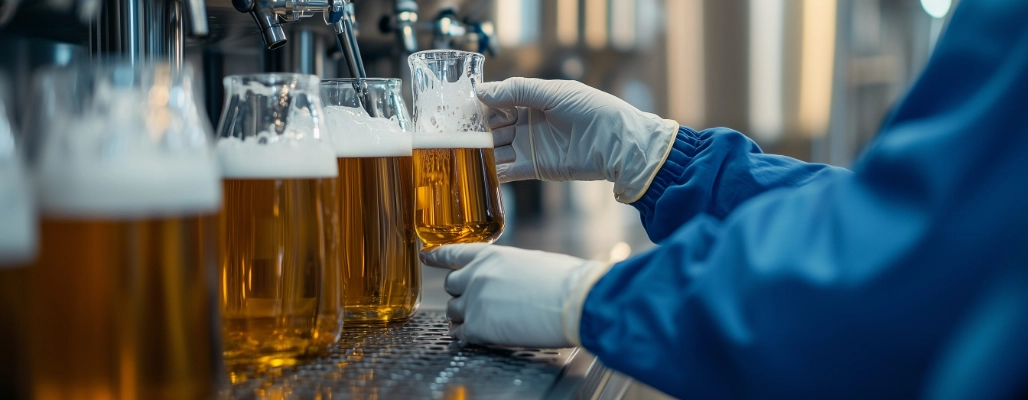
The Role of Free Radicals in Beer Production: Implications and Insights
Free radicals, reactive molecular species with unpaired electrons, play a significant role in beer production.
While both methods provide valuable information about paramagnetic species, they operate differently and are suited for distinct types of analyses. This article explores the differences, advantages, and applications of CW-EPR and Pulsed EPR.
Table of Contents
Formation of Free Radicals in Beer Production
Free radicals are generated at various stages of the beer-making process. Oxygen exposure during production is a major contributor, as oxidative reactions lead to the formation of reactive oxygen species (ROS), such as hydroxyl radicals. These radicals can also arise from enzymatic activity in malt, particularly from lipoxygenase enzymes, which produce hydroperoxides that degrade into free radicals.
Another source is the heat-intensive processes of malting, mashing, and boiling. During malting, the kilning step promotes the formation of free radicals through Maillard reactions, which are responsible for the rich flavors in malt but also generate reactive intermediates. Similarly, the boiling of wort not only sterilizes it but also exposes it to heat and oxygen, further fostering radical formation. Metal ions such as iron and copper, often present in trace amounts, catalyze radical generation through Fenton-type reactions.
Even during fermentation, free radicals may form despite the protective antioxidant environment created by yeast. Finally, storage and packaging introduce new challenges, as residual oxygen in sealed containers can react with existing radicals, exacerbating oxidative stress over time.
Impact of Free Radicals on Beer Quality
The presence of free radicals significantly influences the sensory and physical attributes of beer. Oxidative reactions driven by radicals are notorious for causing off-flavors, such as the stale or cardboard-like taste associated with aging beer. Lipid oxidation, in particular, generates aldehydes that degrade the beer’s flavor profile.
Free radicals also affect beer color by oxidizing phenolic compounds, leading to undesirable darkening. Furthermore, they degrade proteins and lipids essential for foam stability, compromising the visual and sensory appeal of the beer. Over time, these oxidative processes collectively shorten the beer’s shelf life, making free radical control essential for long-lasting quality.
Strategies for Managing Free Radicals
Controlling free radicals during beer production involves minimizing their formation and mitigating their effects. Oxygen management is a critical step. Brewers often take precautions to limit oxygen exposure throughout production, including using inert gases like nitrogen or CO₂ during packaging to displace residual oxygen.
The addition of antioxidants is another effective strategy. Natural antioxidants from hops, such as polyphenols, can neutralize free radicals, while synthetic additives like ascorbic acid or sulfites are commonly used to inhibit oxidative processes. In the malting stage, optimizing conditions to reduce lipoxygenase activity can significantly lower the production of hydroperoxides and subsequent radicals.
Chelating agents, such as EDTA, are frequently employed to bind trace metal ions, preventing them from catalyzing radical formation. Additionally, maintaining equipment to avoid introducing metal contaminants is a practical approach. Cold storage is also effective in slowing oxidative reactions, preserving beer quality during distribution and shelf life.
Future Directions in Free Radical Research
Advances in analytical tools are paving the way for deeper insights into the role of free radicals in beer production. Techniques like Electron Paramagnetic Resonance (EPR) spectroscopy allow researchers to detect and quantify free radicals with unparalleled accuracy. These tools can identify critical points in the brewing process where radical formation peaks, enabling targeted interventions.
By testing the efficacy of antioxidants and exploring alternative brewing methods, researchers are developing innovative strategies to reduce oxidative stress. These advancements promise to enhance the sensory quality and stability of beer, meeting consumer demands for high-quality, long-lasting products.
Conclusion
Free radicals are an unavoidable aspect of the beer production process, influencing flavor, color, foam stability, and shelf life. While their formation is a natural byproduct of brewing, proactive management through oxygen control, antioxidant use, and optimized brewing methods can mitigate their negative effects. As brewing science continues to evolve, the ability to control free radicals will play a vital role in delivering consistently high-quality beer to consumers.
Vanderhaegen, B., Neven, H., Verachtert, H., & Derdelinckx, G. (2006). „The Chemistry of Beer Aging – A Critical Review.” Food Chemistry, 95(3), 357-381.